What is a Superconductor?
Superconductivity: once certain materials are cooled below their critical temperature, their resistance drops to zero — such materials are called superconductors. Taking DC cable as an example, a superconducting cable of the same size can carry up to 20× the current of copper, with extremely low transmission loss. Where space is limited, power density is high and loads are heavy, superconducting cable holds a decisive advantage.
Copper has resistance
Copper resists the current you push through it, and some of that power turns into heat. It is the same reason a phone charger gets warm — and a data center’s energy bill keeps rising.
A superconductor has none
In 1911, scientists found that certain materials lose all electrical resistance once cooled below a set temperature. Current then passes through them with almost no loss.
“High temperature” means cheaper cooling
It still has to be kept cold — but only to −196 °C, cooled by liquid nitrogen, which costs less per liter than bottled water. Older superconductors needed −269 °C liquid helium. That difference is what makes it practical to deploy.
The relationship between Cable, Current and the Power you require
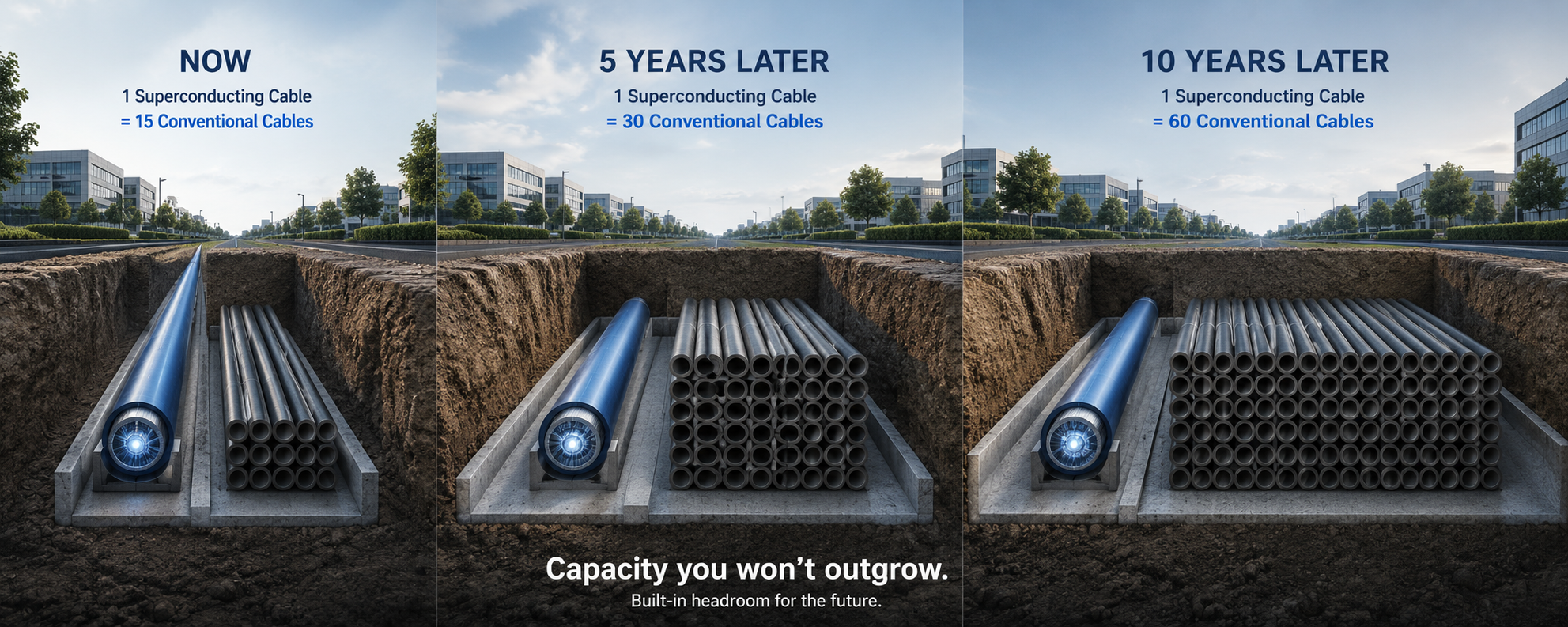
The more current you need, the less copper makes sense. Conventional copper cables are simply not designed to carry too much current. Superconducting cable, on the other hand, is designed to carry enormous current stably and reliably.
The same power, in a single High Temperature Superconducting (HTS ) cable
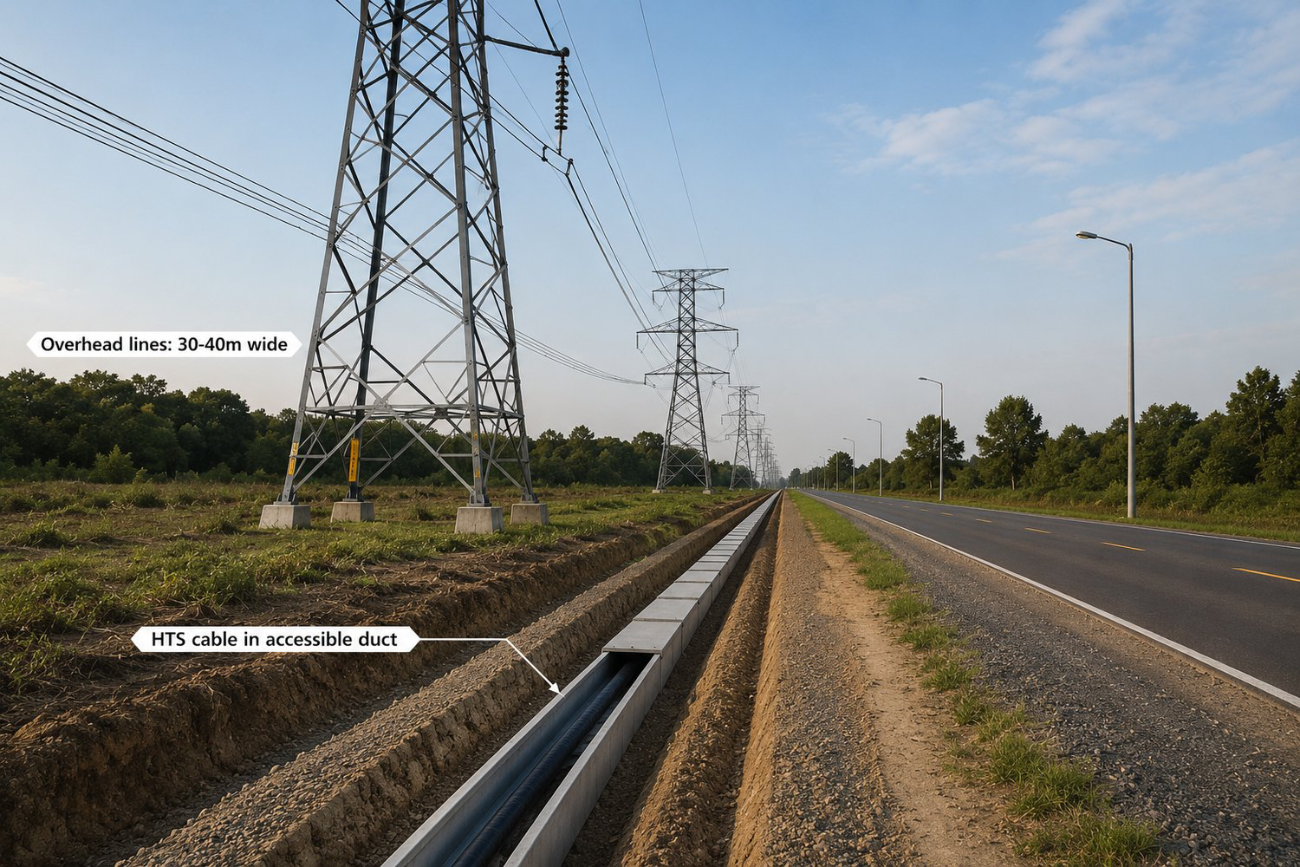
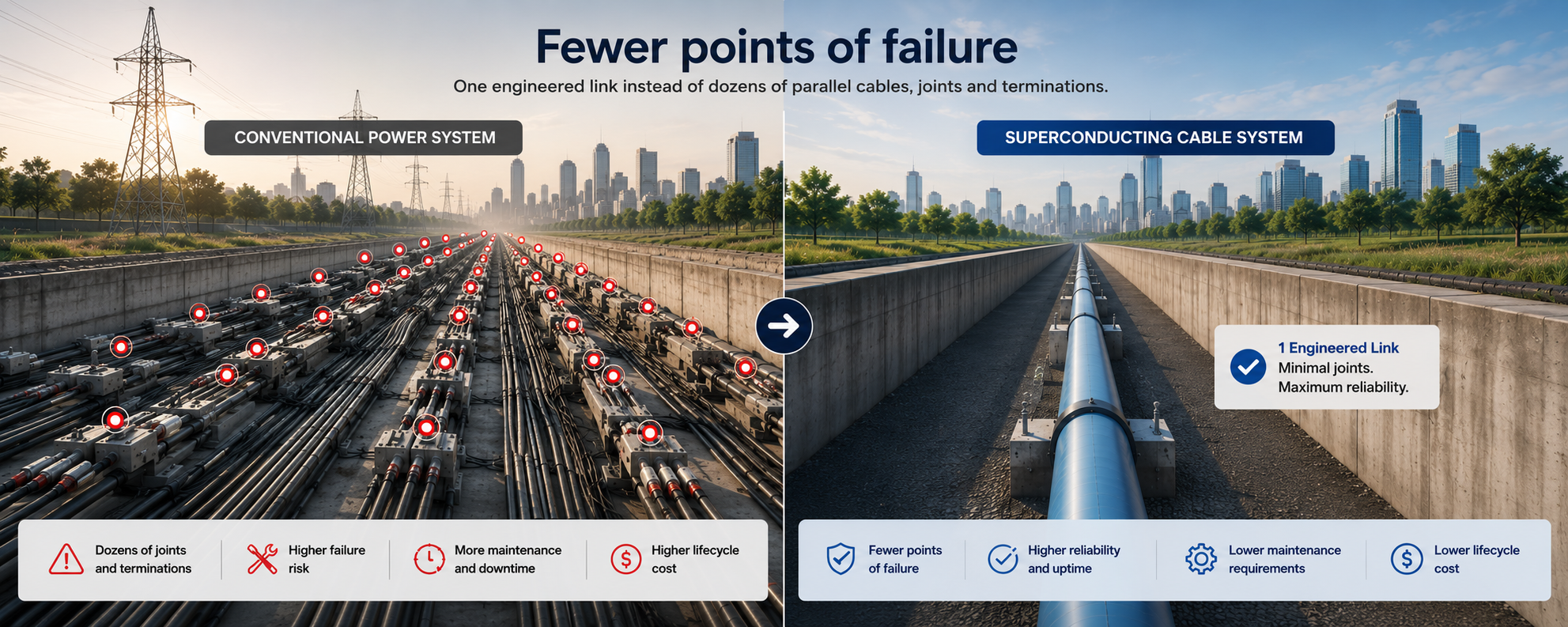
Overhead lines need a 30–40 m right-of-way. The same power runs underground in a slim, accessible HTS duct — up to ~70% smaller than the equivalent copper corridor, often in a route you already own.
Why choose
HTS Superconducting Cable
Most buyers choose superconducting cable for four practical reasons: more power, future-proof headroom, and a lower total cost of ownership — on the footprint and routes they already own.
The only practical way to bring in that much power
At AI-data-center scale, the limit on copper is physics, not cost. One superconducting cable under 250 mm carries what a 300 MW hall needs, at better than 99.99% efficiency, along a route copper cannot fit.
Future-proof for the life of the building
Compute-center power demand roughly doubles every four years. A superconducting cable is laid with several times the headroom from the start, so today’s link still suffices after demand doubles and doubles again — with no re-excavation.
Lower total cost over 10 years
Copper is cheaper to install but more expensive to run — it loses energy as heat for 15–20 years, needs oversized ducts, and is eventually rebuilt. Over a decade, a superconducting link works out cheaper.
See the Cost Comparison →The industry is already moving this way
NVIDIA is moving its AI factories to an 800 VDC architecture. Microsoft has named high-temperature superconductors as a way to relieve the data-center power bottleneck. Utilities already run superconducting links where copper had no room.
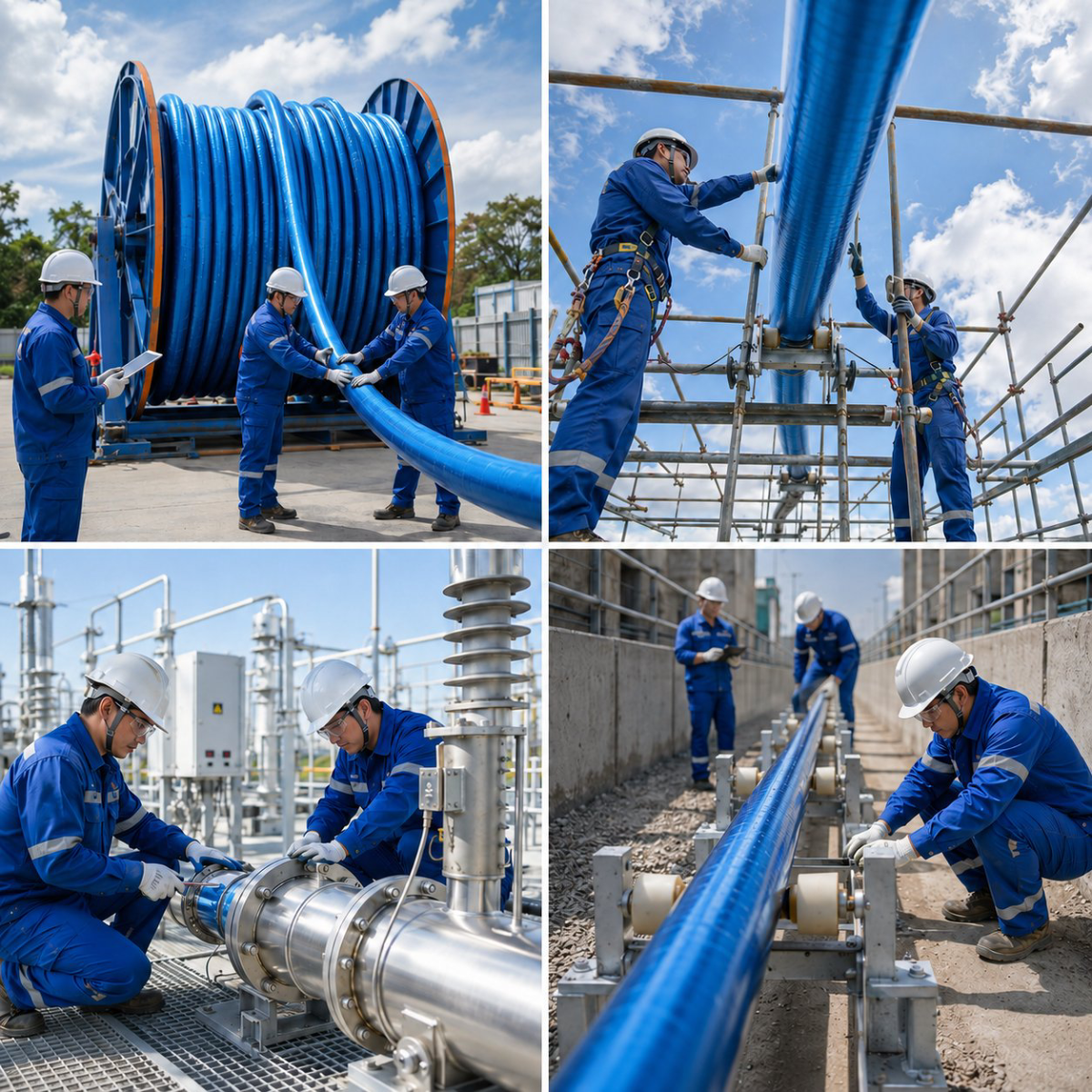
Zenflux is a leading superconducting cable company with proven projects
Our team’s track record spans the full chain: HTS tape production, 35 kV grid-connected AC cable, 10 kV urban distribution, and industrial 10 kA DC — delivered end to end and running in the real world.
AC+DC High Temperature Superconducting (HTS) cables. One clean route.
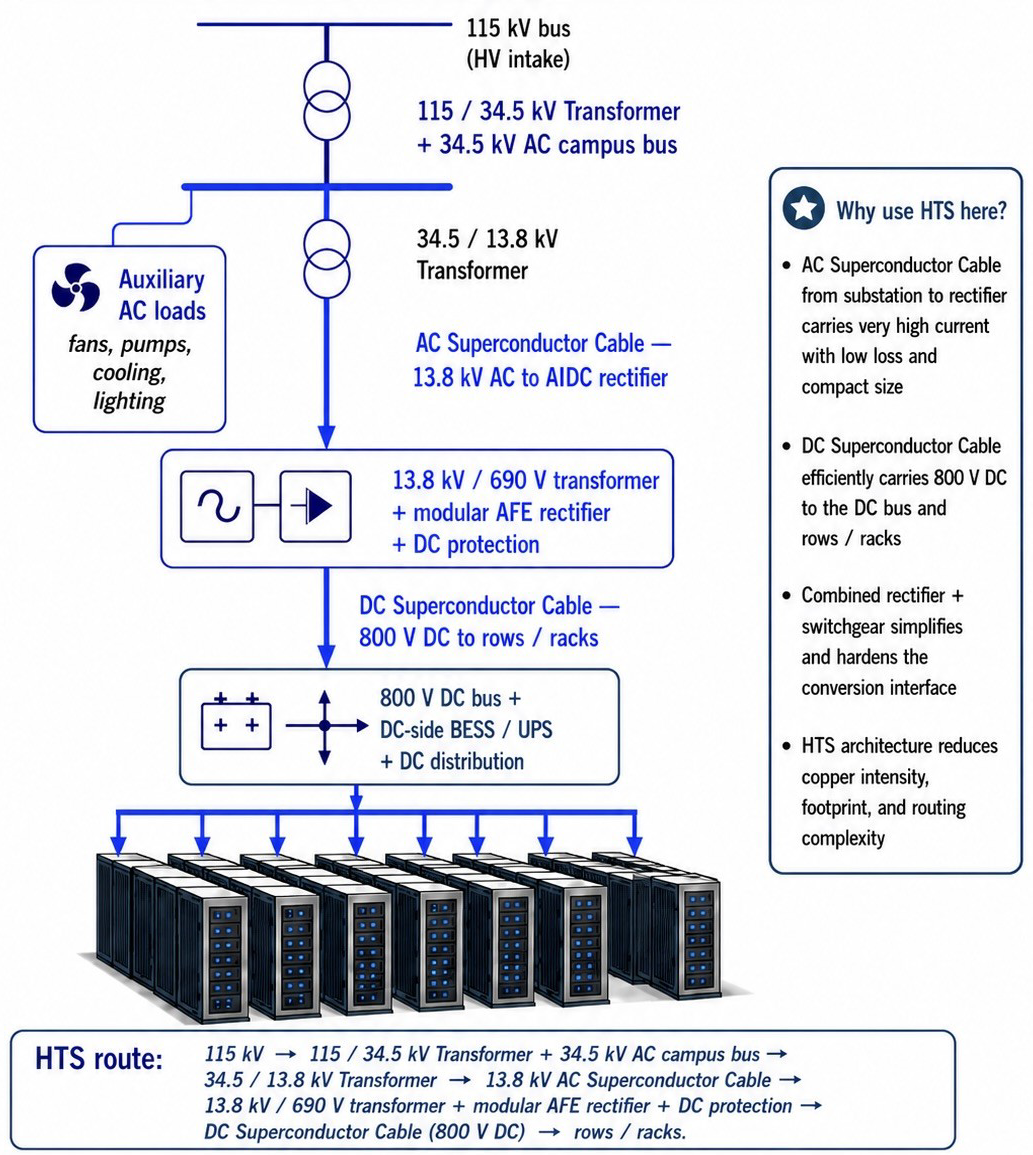
A single AI rack is heading past 600 kW toward 1 MW. Zenflux replaces the copper busbar backbone and overhead busway with one AC superconducting cable into the rectifier and one DC superconducting cable out to the racks — compact, low-loss, and sized to grow with your compute.
Explore AI data center solutions