
Our Solutions

Where power density is high
and copper runs out of room

From AI factories to city grids, industrial DC and renewable integration — our proven capabilities transfer wherever you need to deliver more power in less space, with capacity to spare.

The 800 VDC AI Factory Link

AI data center solutions

A single AI rack is heading past 600 kW toward 1 MW, and site demand keeps doubling. The industry’s answer is an 800 V DC architecture, which NVIDIA is adopting for its AI factories from 2027 — citing up to ~5% better efficiency and up to ~30% lower total cost of ownership. Copper cannot keep up without huge parallel runs and heavy busbars. Superconducting cable can.
The conventional way
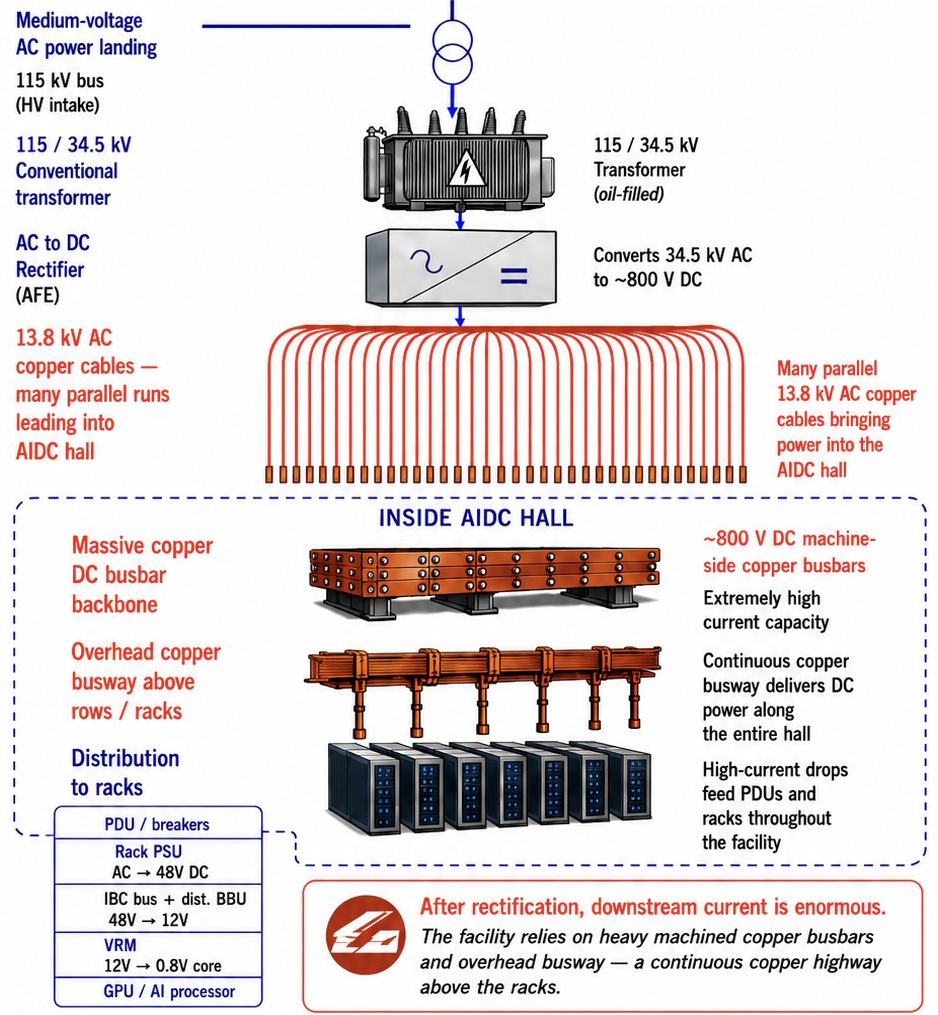
A dense web of last-generation copper cables struggling to power today’s AI infrastructure
Conventional copper route: parallel copper cables, massive busbar backbone and overhead busway
Many parallel 13.8 kV copper cables feed the rectifier; a massive copper busbar backbone and overhead busway then carry enormous current to every rack — tons of copper, a great deal of heat, and a rigid layout that is slow and costly to expand.
The Zenflux way
Two superconducting cables, one clean route
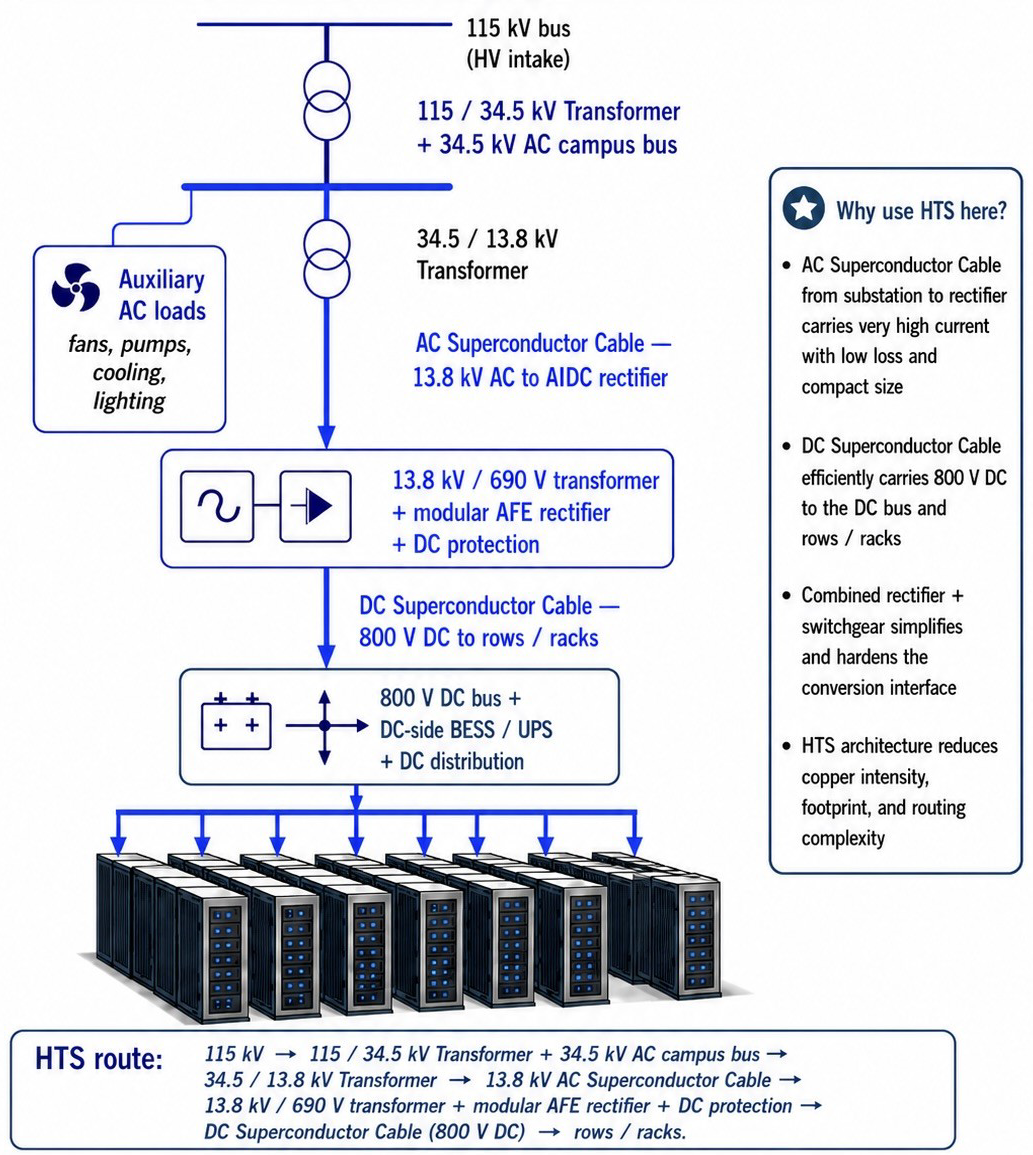
The Zenflux HTS route: one AC cable into the rectifier, one DC cable out to the racks
An AC superconducting cable carries 13.8 kV into the rectifier; after conversion, a DC superconducting cable carries 800 V DC out to the racks. The heavy copper backbone and overhead busway are gone — a compact, low-loss route you size now and grow into.
DC is the natural fit inside the Data Center

Direct current has no AC loss, so a DC superconducting cable runs cooler, uses a simpler build, and costs at least 10% less than an equivalent AC superconducting cable. That is why 800 V DC is the natural home for superconducting power inside the AI data center.

≥10%
Lower cost, DC vs AC HTS
Where It Applies

Where Zenflux HTS Superconducting Cables Are Used

AI data centers

The 800 VDC factory link — megawatt-scale racks fed through one compact, low-loss superconducting route, sized for the compute you install in three years, not just today.

Grid & urban distribution

Medium-voltage links at 10, 35 and 110 kV that carry far more power through the corridors a dense city already has — often avoiding a new substation entirely.

Renewable integration

Move large blocks of renewable power with near-zero loss — connecting generation, storage and load. It is especially suited to offshore-wind “DC grid connection”, delivering a low-cost, high-energy-density transmission solution.

Industrial high-current DC

10 kA-class DC feeders for electrolysis, metal smelting and other energy-intensive lines — moving very high current with low loss, low heat and a compact duct.

Conventional vs Superconducting

Zero-loss power transmission reaches grid-scale reality

Medium-voltage links at 10, 35 and 110 kV that carry far more power through the corridors a dense city already has — often avoiding a new substation entirely.

For a century, moving power has meant accepting loss. Conventional copper and aluminium lines shed roughly 4% of their power on short hops and as much as 15% over long distances — on the order of 6% of all electricity generated, given off as heat and demanding massive towers and wide rights-of-way. Superconducting HTS cable removes this loss: cooled by a liquid-nitrogen system, it carries enormous amount of current with zero, negligible energy loss.
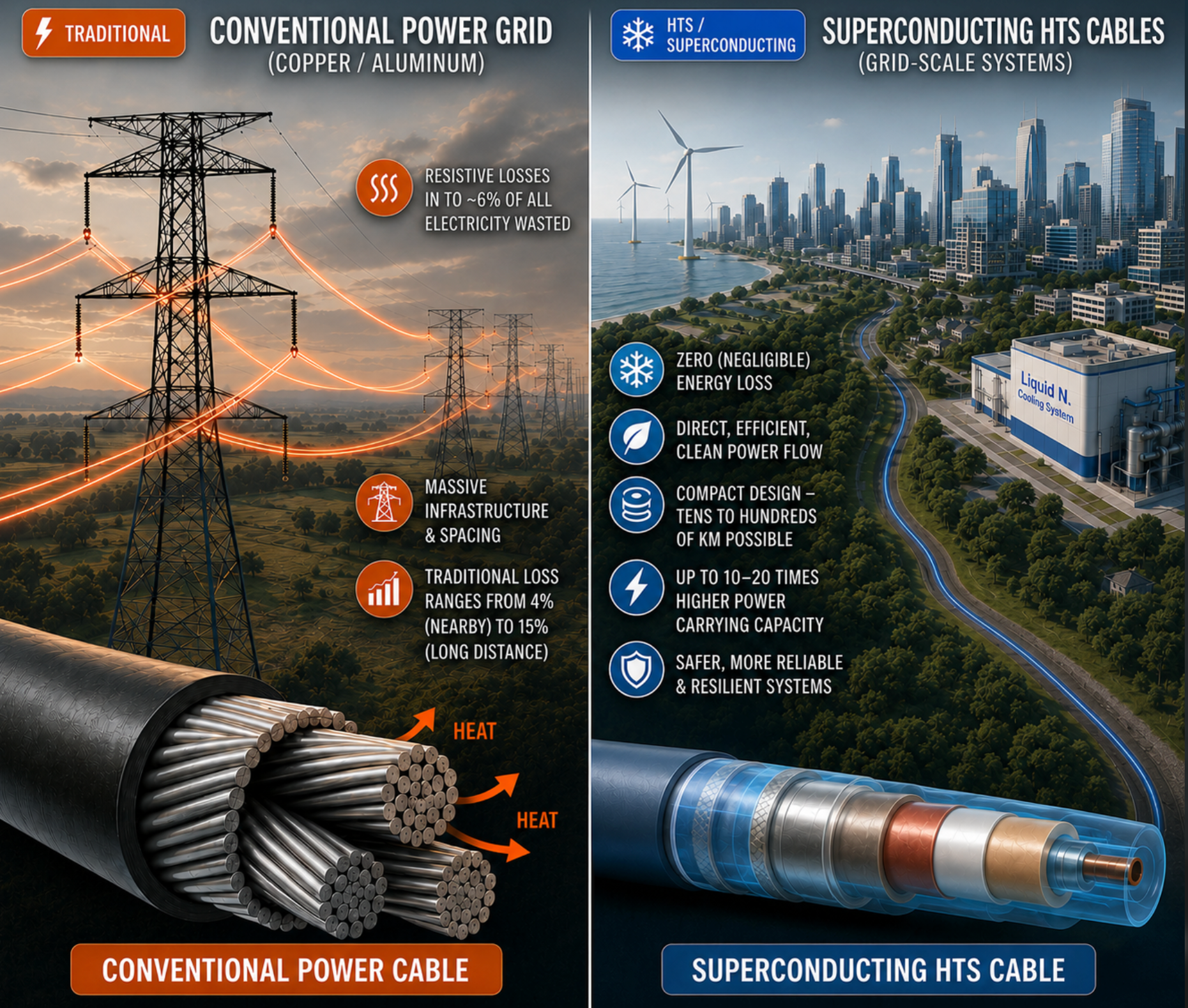
Conventional power grid (copper/aluminium) versus superconducting HTS cables at grid scale: conventional lines waste up to ~6% of all electricity as heat and need massive infrastructure, while HTS cables deliver zero energy loss, direct clean power flow, compact routes of tens to hundreds of km, 10-20x higher power capacity, and safer, more resilient systems.
4–15%
Of electricity lost in conventional lines — rising with distance, wasted as heat for the life of the line.
≈ 0%
Energy lost in an HTS cable — negligible, even across tens to hundreds of kilometres.
10–20×
Higher power-carrying capacity, in a compact route — safer, more reliable and more resilient.

Already Proven on Real Grids

A dense European city center
A single superconducting line carried the load through a corridor barely a meter wide and 70 cm below the street — and the new substation was never built.
1 km / 10 kV1 m corridor
A major US metro
Superconducting wire carried on the order of 200× the current of comparable copper and let the utility reroute power around downed substations — adding both capacity and reliability.
~200× currentgrid resilience
A flagship rail hub
Where a copper plan called for about a dozen cables, two slim superconducting cables under 100 mm did the same job inside busy, space-constrained infrastructure.
2 cables <100 mmreplaced ~a dozen

Underground Superconducting HTS cables
already run in major cities

Across transmission, sub-transmission and distribution voltages, our proven capabilities cover the whole system — from material to field operation.
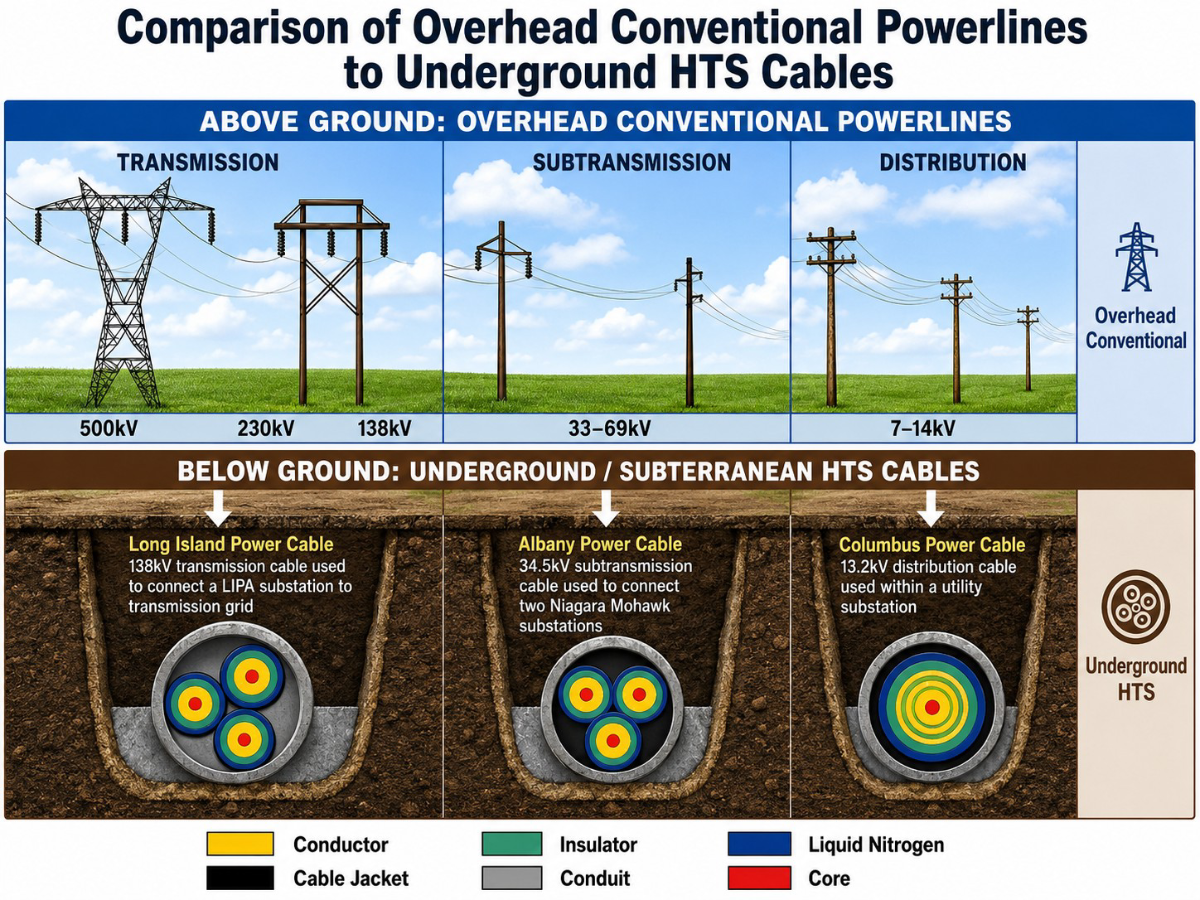
Overhead transmission versus slim underground HTS route, already running at grid scale in major cities
Have a unique project in mind?

We design the cables around your requirements

Rack density, phasing, redundancy and site all differ. Tell us your load and we’ll size the AC and DC link, cooling and terminations to your roadmap.

Compare the cost Contact our experts